Thursday, July 25, 2024

Research Paper: Dropping Out Notes


            Asked to consider the factors that determine the influence of working part time on graduation


Nearly half (47 percent) said they left because "classes were not interesting."

Nearly seven in ten -- 69 percent -- said they were "not motivated" or "inspired to work hard," even though two-thirds said they would've worked harder if more was demanded of them.


            I remember a photograph I saw years ago in a National Geographic magazine.  It was taken in a New York City ghetto:  a mother and her 10-year-old son in a tiny apartment bedroom.  They sat close to each other, on the edge of a single bed.  Taken from above, a mother held her arm out, showing her son the needle “tracks” that covered it.  She was just home from detox, telling her son that he should never put drugs into his body because they were bad for him.  Growing up surrounded by drug traffickers and junkies, this boy had been hired by the neighborhood grocer to sweep out the store after school every day.  The grocer couldn’t pay much, but he encouraged the boy to do his homework, finish school and go on to college.  From somewhere, this young boy had found the inner drive to reject the quick money he could have earned as a runner for drug sellers.  He wanted to become a doctor so that he could help people who were sick like his mother.  Although young Oren Etzioni wasn’t raised in Hell’s Kitchen, he demonstrated an equal, innate sense of what was right.  Refusing to steal from his employer, Oren exemplifies the inner desire to do what is right that this 10 year old child exhibited.  A Etzioni, in his essay “Working at McDonald’s,” offers the example of his son’s experience as a reason why high school students should not work part time jobs. (Etzioni 296) 

Etzioni has decided that teenagers drop out of school because they work part-time fast-food jobs.  His essay, while logical on the surface, tries to convince his reader that they need to keep their high school students  who work part time at fast food establishments because they have an increased dropout rate, are thrust into a limbo-esque environment where "all too often delinquent teen values dominate,"  (296) and become enamored with "objects of no intrinsic educational, cultural or social merit."  (296)


3

in discussing this third concern appears, Etzioni adopts an obviously sarcastic mode: "this is only fair and square; they are being fed American consumers and spend their money on what turns them on."  (296)  The reader is to instinctively fall in with those educators who bemoan the fate of these ignorant, "young, yet uninformed individuals, . . . [who] learned so quickly the dubious merit of keeping up with the Joneses in ever-changing fads, promoted by mass merchandising."  (296).  He dismisses, almost automatically, those "among the poor" who use this part-time job income to "support themselves"-- and those middle-class students, who "set some money aside to help pay for college."  (296)


s about teenagers who work part-time jobs, while they were in high school.  Is that they may have an increased chance of dropping out.  The reasons that he gives for this is that these jobs, while inappropriate for college-bound, upwardly mobile teams, are ideal for lower class, minority youngsters. 

The reasons that students drop out are varied:  none reported by The Silent Epidemic include part-time work.  Some who dropped out said that classes weren’t interesting.  Others missed too much school and couldn’t catch up.  Some reported that they had too much freedom at home—not enough rules, not enough demanded by teachers or expected of them by their parents. Feeling unmotivated, 70% of these students who dropped out, felt that they could have graduated “if they had tried.” (Bridgeland) 

A 2006 survey, The Silent Epidemic, put these questions to a group that isn’t usually asked for opinions on American education—high school dropouts. The study found that while some students drop out because of significant academic challenges, most dropouts are students who could have, and believe they could have, succeeded in school. The study sheds light on a number of important questions, including:


Etzioni does hit on one factor leading to high school drop out: “For almost all young people, dropping out of high school is not a sudden act, but a gradual process of disengagement.” (Bridgeland)    The reasons why students drop out are as varied and complex as the students themselves: essentially, though, it comes down to the child’s inability to see beyond the “here and now” of her own situation.  


For this reason, working a part time job is actually an opportunity for high school aged children to begin to comprehend a wide world that they have never before been able to imagine.  The monotony of the Burger King assembly line, rather than enslaving the worker, provides the opportunity for a student to learn that in order to reach certain goal, specific steps must always be taken.  Outside of their family, outside of their circle of friends, outside of the classroom, outside their community a teenager’s influence on others and ability to excel personally, will depend upon her ability to learn that every desired end follows from a prescribed process.  Remembering to make fresh coffee every eight minutes, to press certain buttons on the register that allow the business to track its income, and the sheer will necessary for everyone at some point to "have the gumption" (Etzioni 294) to be where you need to be—even when you don't want to be there—is an opportunity to begin the process of maturing into a responsible adult.  Even the most inventive, delicate craftwork that men and women can undertake, violin making, drawing architectural plans, fashioning a new polymer for industrial use, constructing the micro-sized motor that can power an artificial heart—all of these endeavors require constant, repeated, monotonous, continual, repeated practice.  A gourmet chocolatier, book editor, engine mechanic, legal assistant, genetic physicist, English composition teacher, linguistic analyst, veterinarian’s assistant, hospital admitting clerk, or fine artist who paints in oils: all must repeat, again and again, the steps necessary for them to complete their job.


Students who drop out ultimately do come to understand the importance of a high school graduation diploma.  As adults, the overwhelming majority of drop outs said that “finishing

high school was important to success in life.  Three-fourths (74 percent) said that if they were able to relive the experience, they would

have stayed in school.” (Bridgeland) 


Teenagers limited by poverty-level living conditions and the absence of positive parental support are the dropouts stuck in Etzioni's low-paying, routinized, dead-end jobs.  These jobs, however, are not the reason why these students give up high school.  A 2006 survey of high school dropouts from across the nation, revealed that only 32% of all those who dropped out did so because they need to get a job to support themselves.   of these dropouts were young women who had become pregnant and needed to support themselves.  They did not stop attending school.  So that they could earn extra spending money every week to buy new clothes, they dropped out of high school, because they needed to become full-time wage earners.


dropout. The stereotype suggested that what separated dropouts from graduates were character flaws - personal traits of someone who could not adjust to high school and who was too ignorant to understand the consequences of leaving school.


Poverty still makes a difference in who graduates. That - not the absolute number of graduates or dropouts - is the real dropout problem. Dropouts: Shadow of high school graduation

Copyright © 1997-2004, Sherman Dorn

http://www.coedu.usf.edu/~dorn/research/dropouts/shadow.html


What Dropouts Believe Would Improve Students’ Chances

Opportunities for real-world learning

(internships, service learning, etc.) to

make classroom more relevant

Better teachers who keep

classes interesting

Smaller classes with more

individual instruction

Better communication between parents

& school, get parents more involved

Parents make sure their

kids go to school every day

Increase supervision at school:

ensure students attend classes

This would improve students’ chances of staying in school

81%

75%

71%

71%

70%

Top Five Reasons Dropouts Identify as Major

Factors For Leaving School

Classes were

not interesting

Missed too many days

and could not catch up

Spent time with people

who were not interested

in school

Had too much freedom

and not enough rules in my life

Was failing

in school

47%

43%

42%

38%


Bridgeland, John M., John J. DiIulio, Jr., Karen Burke Morison.  “The Silent Epidemic:  Perspectives of High School Dropouts.”  Peter D. Hart Research Associates for the Bill & Melinda Gates Foundation.  March 2006. Web. 12 June 2009. http://www.gatesfoundation.org/united-states/Documents/TheSilentEpidemic3-06FINAL.pdf


35%

The Silent Epidemic

Perspectives of High School Dropouts

A report by Civic Enterprises in association with

Peter D. Hart Research Associates

for the Bill & Melinda Gates Foundation

By: John M. Bridgeland

John J. DiIulio, Jr.

Karen Burke Morison

March 2006  http://www.gatesfoundation.org/united-states/Documents/TheSilentEpidemic3-06FINAL.pdf

What might have kept dropouts in school?

  • 81 percent called for more "real-world" learning opportunities.
  • 75 percent wanted smaller classes with more individual instruction.


Monday, January 8, 2024

Two Photos of Earl and All About Her--July 2022

       
My Earl


Earl was a female flying squirrel.  Native to Florida, she was brought into the Sanctuary because of an injury.  I think that she spent most of her early life with a family of six or so others in a very small display section of the Sanctuary gift shop.  I assume that she was unable to be released—or given up to a care center with people who were better able to raise flying squirrels. 


By the time that I was an experienced volunteer, she had been hidden away in a cage placed in the hospital.  I’ve written and talked about the steps I took to give him exercise time and a more complete quality of life.  It came to a point where the people in the hospital had to force feed a raptor who was being prepared to regain enough strength to be released—unfortunately they chose to do this next to Earl’s cage. 


I pointed out that Earl must be terrified by the noises the bird made as it screeched between bites.  No one there even considered the situation they were creating for Earl.  She was having to endure the calls from one of the birds most able to catch and eat her.

This began my efforts to move Earl to my own home. I reminded the staff that no one was interacting (except to feed her treats) with her except me.  I had a "pet free” home with plenty of space for evening exercise sessions.  She had no records that anyone bothered to find and update.  She was so comfortable with me that I could put her between two shirts tucked in at my waist while I tended to the other animals, did dishes, folded laundry and cleaned.  She mostly slept in the lower hollow of my back.  I would reach back and rub her through the outer layer of shirt. 


She would sometimes wake and come to peek out beneath my chin at the world moving by.  

Earl was, essentially, mine except for where she lived at night.  

Employee turnover was incredibly quick (most stayed less than a year because of low pay, high stress, and run down facilities).  The hospital staff was no different—new “directors” of the hospital came and went.  I had been there longer than most of the staff—and so I carried on with the routine of physical events before the director was settled and could decide what, where and when, she wanted things done. I’m sure that was an irritating feeling—having duties done without their direction.

I argued with the most recent director about quality of life, purpose of the hospital, Earl’s health and vitality.


Before that director left, she let me take him.  The saving grace was that since Earl had no records, she couldn’t be in the hospital.

I immediately took her to a wild life specialist and discovered that she had an enlarged heart.  I already knew that she was over weight. 

The time I had with Earl was short, but she remains with me: her warm, soft body as she fell asleep in my hands, the tiny scratches from repeated trips up my bare arms, her growling-sharp call when she was upset.  Most of all, I remember her amazing ability to climb and fly over so many things in our home—after which she would find and return to me. 

Only when I have cradled my own three children—been their main source of attention, comfort and food—have I been able to feel so attached to something so small.


Monday, November 6, 2023

Earl of My Heart

The Lord's tests are not to control you, they are to challenge you to become better.

Elder Eyring


Gift of Heart to a Flying Squirrel that only stayed awhile.

Earl was surrendered to Busch Wildlife Sanctuary so long ago that no one remembers when he came.  He was placed in the Hospital building in a 4' x 4' x 4' cage.  He was fed and his cage was cleaned once a day. He was small and quick, immediately endearing with huge, black eyes built for seeing in the dark. He was also equipped with very hard, very sharp teeth--which he used effectively when someone tried to touch him or pick him up.  If you were to interact with him, it would be on his terms.

Call his name.  If he showed a sliver of his nose, offer him a bit of nut or sunflower seed.  After a moment of consideration, he would gently take the proffered treat and then slip back inside his sleeping pouch.  

If he did not appear, stay away and try later.  

He never did adapt to play during the day.  Sometimes, when he was very lonely, he would come out and spurt up an offered hand and arm.  Instantly he would slip into a keeper's sweatshirt hood--or (he preferred) under the neckline of a loose shirt--skittering around under arms and around your belly to find a tight spot to cram in to.

After years of only coming out to accept a peanut or a mealworm ("I can get Earl to do anything for a mealworm," one keeper would boast.), Earl was more like a plump hamster with a short, flat feather of a tail than the lithe, sliver of fur and feet designed to float from height to height.

Sunday, June 26, 2022

Talk Earl/Seek Ye Diligently June 2021

June 2021Talk


Doctrine & Covenants 88:118

And as all have not faith, seek ye diligently and teach one another words of wisdom; yea, seek ye out of the best books words of wisdom; seek learning, even by study and also by faith.

This morning I would share with you how thankful I am for the opportunity to seek.

When I was in school, I read about an experiment about how we came to know that small units of matter acted, not as particles or waves—but as both particles, and as waves.  A beam of electrons was directed at a screen.  In between the two was a panel with two open, vertical slits.  

When the experiment was left to run unobserved, then they acted as waves, then one vertical area would appear on the screen.  The electrons had passed through the slits and then joined the single stream again. 

However, if an experimenter was watching the beam and screen, the screen showed two vertical areas. The electrons were passing through each slit and continuing on straight—as a particle would.

REHOVOT, Israel, February 26, 1998--One of the most bizarre premises of quantum theory, states that by the very act of watching, the observer affects the observed reality.

researchers at the Weizmann Institute of Science conducted a highly controlled experiment demonstrating how A beam of electrons is affected by the act of being observed. The experiment revealed that the greater the amount of "watching," the greater the observer's influence on what actually takes place.

The research team headed by Prof. Mordehai Heiblum, included Ph.D. student Eyal Buks, Dr. Ralph Schuster, Dr. Diana Mahalu and Dr. Vladimir Umansky. The scientists, members of the Condensed Matter Physics Department, work at the Institute's Joseph H. and Belle R. Braun Center for Submicron Research. 

When a quantum "observer" is watching Quantum mechanics states that particles can also behave as waves. This can be true for electrons at the submicron level, i.e., at distances measuring less than one micron, or one thousandth of a millimeter. When behaving as waves, they can simultaneously pass through several openings in a barrier and then meet again at the other side of the barrier. This "meeting" is known as interference. 

Strange as it may sound, interference can only occur when no one is watching. Once an observer begins to watch the particles going through the openings, the picture changes dramatically: if a particle can be seen going through one opening, then it's clear it didn't go through another. In other words,when under observation, electrons are being "forced" to behave like particles and not like waves. Thus the mere act of observation affects the experimental findings. 

To demonstrate this, Weizmann Institute researchers built a tiny device measuring less than one micron in size, which had a barrier with two openings. They then sent a current of electrons towards the barrier. The "observer" in this experiment wasn't human. Institute scientists used for this purpose a tiny but sophisticated electronic detector that can spot passing electrons. The quantum "observer's" capacity to detect electrons could be altered by changing its electrical conductivity, or the strength of the current passing through it. 

Apart from "observing," or detecting, the electrons, the detector had no effect on the current. Yet the scientists found that the very presence of the detector-"observer" near one of the openings caused changes in the interference pattern of the electron waves passing through the openings of the barrier. In fact, this effect was dependent on the "amount" of the observation: when the "observer's" capacity to detect electrons increased, in other words, when the level of the observation went up, the interference weakened; in contrast, when its capacity to detect electrons was reduced, in other words, when the observation slackened, the interference increased. 

Thus, by controlling the properties of the quantum observer the scientists managed to control the extent of its influence on the electrons' behavior. The theoretical basis for this phenomenon was developed several years ago by a number of physicists, including Dr. Adi Stern and Prof. Yoseph Imry of the Weizmann Institute of Science, together with Prof. Yakir Aharonov of Tel Aviv University. The new experimental work was initiated following discussions with Weizmann Institute's Prof. Shmuel Gurvitz, and its results have already attracted the interest of theoretical physicists around the world and are being studied, among others, by Prof. Yehoshua Levinson of the Weizmann Institute. 

Tomorrow's Technology 

The experiment's finding that observation tends to kill interference may be used in tomorrow's technology to ensure the secrecy of information transfer. This can be accomplished if information is encoded in such a way that the interference of multiple electron paths is needed to decipher it. "The presence of an eavesdropper, who is an observer, although an unwanted one, would kill the interference," says Prof. Heiblum. "This would let the recipient know that the message has been intercepted." 

On a broader scale, the Weizmann Institute experiment is an important contribution to the scientific community's efforts aimed at developing quantum electronic machines, which may become a reality in the next century. This radically new type of electronic equipment may exploit both the particle and wave nature of electrons at the same time and a greater understanding of the interplay between these two characteristics are needed for the development of this equipment. Such future technology may, for example, open the way to the development of new computers whose capacity will vastly exceed that of today's most advanced machines. 

This research was funded in part by the Minerva Foundation, Munich, Germany. Prof. Imry holds the Max Planck Chair of Quantum Physics and heads the Albert Einstein Minerva Center for Theoretical Physics. 

The Weizmann Institute of Science, in Rehovot, Israel, is one of the world's foremost centers of scientific research and graduate study. Its 2,400 scientists, students, technicians, and engineers pursue basic research in the quest for knowledge and the enhancement of the human condition. New ways of fighting disease and hunger, protecting the environment, and harnessing alternative sources of energy are high priorities. 


Story Source:

Materials provided by Weizmann Institute Of ScienceNote: Content may be edited for style and length.


This [fact] . . . may be used in safe-keeping our future internet information transfers--like emails and texts.

Prof. Heiblum. "[Programing could be written that] would let the recipient know . . . the message has been intercepted..


Just by having someone watch what you have written and sent, you can know if someone else is watching..

When we were watching, seeking, we were able to detect the truel nature of electrons.


During the past 15 years, I have spent years, on and off, studying Florida’s plants, environments, and landscaping.  At one point I was compiling an album of plant samples, with photos and a description of the plant.  


I wanted to do a page on silver buttonwood trees.  There was one in our front yard that was almost dead, and I wanted to find healthy samples for my album. 

I was worried because I couldn’t remember seeing one anywhere in the city.

I began to focus on finding the distinct, silvery leaves and small pine-cone-like seeds.


Suddenly, I was paying attention to the trees around me—and I began to see silver buttonwood trees everywhere.  

They were planted along community streets, in the middle of two-way avenues, in office complex parking lots.  

They were everywhere!  I just had not been paying attention.

When I began to look for them, they appeared. 

It seems that there are a myriad of things that only appear when we—when I—open my eyes to see.  


Doctrine & Covenants 88:118

And as all have not faith, seek ye diligently and teach one another words of wisdom; yea, seek ye out of the best books words of wisdom; seek learning, even by study and also by faith.


If we are not “seeking” then we will not be able to see faith, teach others [for in teaching we ourselves learn the most], know which are the best books.  We will not be able to learn what we need to return to Heavenly Father.


Laman and Lemuel could not see the truth even after witnessing an angel, after being forced to the ground by Nephi’s mere putting his hand out toward them, after nearly being drowned at sea.  They could not learn faith, could not understand the sweet affirmation of the Spirit that only appears after we seek for it.


On June 1, 1978, President Kimball announced:  we have pleaded long and earnestly in behalf of these, our faithful brethren, spending many hours in the Upper Room of the Temple supplicating the Lord for divine guidance.

He has heard our prayers, and by revelation has confirmed that the long-promised day has come when every faithful, worthy man in the Church may receive the holy priesthood,

Enos received a remission of his sins only after wrestling all day and all night until his voice reached the Heavens.


Centuries of scientists sought to know the truth about how electrons traveled.

I watched every tree I could find until I discovered the truth—silver buttonwood trees are all around me.

President Kimball “plead long and earnestly.”


There is no end to that which we can find by seeking. 


I am able to volunteer at Busch Wildlife Sanctuary—working in the hospital, caring for the animals, and going out with education to teach others about the Florida’s endangered creatures.


There are animals that stay at Busch because they have are habituated to humans and cannot be released into the wild.


Recently, I began looking around for animals that were not receiving any enrichment time—did not have anyone who paid attention to them on a daily basis. 


Earl lives in a large cage in the busy hall of the hospital.  He can see everyone coming and going and everyone stops for a moment to say “Hello!”


Earl is a flying squirrel, though, and so is nocturnal.  His body has learned to wake during the day to get the best parts of his food.  Most of the time, he sleeps.


I was inspired to ask if I could take Earl to a specially prepared room and let him run and jump and fly.  


Every day that I can, even if I am not scheduled to volunteer, I go to Busch and prepare the bathroom—covering dangers and putting towels along the rails.  Then I get this flying squirrel and take him with me.  

His first three times he hesitantly explored the rails and made small jumps.  It was more than he had ever had in his life.  But it was not enough.  On the fourth day, I was prompted to TURN OFF THE LIGHT.  

He seemed to bloom.  He ran along the rails and jumped from me to the blanket-covered toilet and back to my shoulder. He took laps around my middle and then jumped up onto the rails again. It was a lot more than he had before.  But it was not enough.

He kept looking for something higher to jump on to.


Another prompting: get a ladder!

The next day I placed the four --step ladder in the center of the room and covered it with a blanket.  I went to get Earl, sat down and turned off the light.  His tiny face peered out of his carry sac.  

He took a moment to assess the environment, and then he morphed into a small streak of energy.

He jumped onto the ladder tower and then ran down the back and scampered behind the cover on the ladder and came up on the other side.  He zipped up to the top again and then balanced on his toes—jump to the sink? Jump to the railing? No! Jump onto my shoulder and then to the railing behind me and back up to the ladder.  He was like an electron—passing through space and weaving from rail to rail, from my shoulder down my back and around—flinging himself up to the top of the ladder and then scrambling behind the blanket and back up to the top and then to my shoulder.  After about 45 minutes of this, he secreted himself at my back, under my shirt, suddenly still and quiet and round.  

I reached around and cradled his tiny body, rubbing down and around his soft, curled body—no heavier than a large marshmallow.

I put him back in his cage and gave him a bit of peanut—which he carried back to his sleeping place.  By the time I had put the bathroom back to rights—he was asleep again.  

I reached into his soft cubby and held him with my fingers around him—a last time body rub.


In consciously looking and paying attention, we can discover the truth.  We can see the dual nature of electrons, the abundance of buttonwood trees in Palm Beach, reveal new revelations from God, and find the pure joy that the Lord created in tiny flying squirrels.


Doctrine & Covenants 88:118

And as all have not faith, seek ye diligently and teach one another words of wisdom; yea, seek ye out of the best books words of wisdom; seek learning, even by study and also by faith.


Wednesday, August 25, 2021

The Beginning of the End of the World as I've Seen It

25 March 2020

Over the last two months the rate that the world has been changing has accelerated at an every increasing speed.  It's not that the earth has altered physically, but the state of the human beings who live thereupon has turned upside down.  A virus.  One of the tiniest viable particles known, the Corona Virus has halted all air, sea, and land travel.  Non-essential businesses have been closed for more than a week.  Grocery stores and the trucks that supply them, gas stations and semis full of fuel to refresh the local supplies--car repair and drug stores--doctors' offices . . . and, of course, hospitals are all still active.  The city couldn't function without garbage collection and the mail and package deliverers. 

With the population all suppose to be confined to their homes--but we do have a yard and a pool.

More tomorrow.  

I'd always imagined that wars between nations, earthquakes, tsunami, hurricanes, fires and tornadoes would be the primary means of man's end.  This peacefully quiet absence of individuals is more like a scene from one of the apocalypse science fiction stories I've read over the years.  

YouTube videos have been following the CoVid-19 challenges by dredging up facts about past epidemics, promises to post videos daily rather than weekly, videos from people on lock down, and the obvious 24/7 news reports keeping everyone up-to-date on what is happening in the world because of the virus' appearance in the public domain.


Monday, May 9, 2016

Double Pinwheel Tree Blossom


This was taken this morning.  My photo.

Double Pinwheel blossom Apocynaceae Tabernaemontana divaricata, Crepe Jasmine or Pinwheel Flower.

When we first moved into our Florida home, there were six Tavernaemontana divaricata trees growing just east of the front door.  With rich, lush dark green leaves, they were wonderful just by themselves.  In the summer, however, they continually blossomed with small, white, 5-petaled flowers.  Unfortunately they were already overgrown, too big for the space they had been planted in.  Greedy for sun, they pushed their branches up and outward, looking for all the world like trees bent by constant, gail-force winds.  

After a time, I had help digging them up, roots intact, and transferring them to a place in the back yard where they had lots of room to grow.  


Palm Beach Gardens, FL.  My photo.

One little sapling escaped our notice.  Sprouted from a seed, it gradually increased in size and beauty.  Once stunted by the primary cluster of trees, it is now alone, but very happily growing, at the corner of our house and the garage.  I keep it pruned down low--about 5 to 6 feet tall.  Usually it bears the plain flowers, like the one in the photo below.

From a site on-line: ZDNet.com.  The photo is credited to Image by rjackb via Flickr.  This post was originally published on Smartplanet.com 
This morning I found a single flower that surprised and delighted me.  I took a photo of it--the one at the top of this entry:  a double layered flower with two sets of petals set on top of one another.  It is still beautiful--nine hours after I picked it.  It doesn't wilt like the gardenia blossoms I pick and bring inside.  

I've never seen a flower like this on this particular tree before.  

I suppose it's a vote for genetic mistakes as a good thing.

Tuesday, May 3, 2016

"Drive-By" Gardening; Silk Floss Tree

Garden "wellies."  My art.

Usually when I am gardening I dress in an old, stained pair of overalls.  They are blue and white pinstripe and have splotches of white paint across the front pockets.  Even though I bought a size "small" they are much too big for me and years ago I shortened the legs so that their bottom edges didn't drag the ground.  I also sewed the shoulder straps in place because they kept working their way loose as I worked.  They have great pockets that I empty of soil and crumpled leaves at the end of the day.  The knees are reinforced with no chance that I would ever have to patch holes.  
My overalls.  My photo.

I wear an old shirt--usually a hand-me-down from Nathan that shrunk in the dryer.  I keep a few of them just for gardening and so I can start with a fresh tee shirt for several days in a row without stopping to do laundry.  I also bought myself some black "wellies" from Walmart more than a decade ago that I step into and out of at the door as I come and go from inside to outside--it keeps the dirt that I drag into the house to a livable minimum.  

Before going out I smear my face with sunscreen and spray my arms with mosquito repellant.  I pull on a floppy canvas hat to complete the look.

Thus prepared, I pull on a pair of gardening gloves and load a big bucket with pruners, clippers and a small tree limb saw.  I also usually drag a big, empty garbage container with me so I can collect anything I pull up or cut off as it is pulled or cut.  

In a word--when I work in the yard--I look like I am working in the yard.

Three days ago Lauren came looking for me outside.  Caleb toddled beside her, holding her hand and picking his feet up a little higher than usual (I think the stiff Florida grass tickles his feet).  She found me in the front yard--pruning the inner branches of a hibiscus tree.  I was dressed in jeans and one of my "good" tee shirts.  My feet were bare--though I did have gloves on.  

Lauren approached me and stopped, picking up Caleb so he wouldn't continue to pull on her hand.  

"Hi, mom.  I couldn't find you inside.  You doing some drive-by gardening?"  

I looked back at her with a questioning look--you know one eyebrow up and one eyebrow down.

"Well . . . you're not dressed like usual . . . and you didn't tell anyone you'd be out gardening."

**********************

Drive-by gardening.  Doing something without planning before hand.  Getting caught in the middle of working on something I didn't really mean to be doing.  With yard work, that can be a bad thing for me--shoulder, hands, wrists, knees have all been repaired frequently in the last few years.  

Yesterday we celebrated Lauren's birthday and a (hated) family tradition (that I insist on--another story) is the giving of a "wish" to the person whose present you are about to open.  Lauren wished that Brent would find some really cool fossils the next time he went to the Peace River to search for them.  I was next.  

After rolling her eyes and thinking hard, Lauren said, "I wish that you won't have to have more surgery on anything this year."  

Unfortunately a very appropriate wish; already this year I had to have a severed tendon in my right wrist repaired. 

************************

NEW SUBJECT

************************

Silk Floss Trees
Bombacaceae Chorisa speciosa

Ever since we moved here eleven years ago I have alternately felt pity and awe for the Silk Floss tree.  

Through the late fall, winter and spring, the trees look like something from a Tim Burton movie.   

In late fall and winter the crepe murtles are flush with bright purple, red and pink fluttered flowers.  In spring the gardenia trees and tiny jasmine flowers fill the air with a delicious fragrance.  My wild roses produce hundreds of blooms all year long.  Hibiscus bushes and trees boast huge flowers in yellow, flaming orange, bright crimson, and blood red.

In contrast, the Silk Floss tree stands barren almost all year long.  When I first saw the row of trees along Donald Ross Avenue standing naked and crook-branched, I wondered out loud why they didn't just pull them down and put in something that would be able to thrive along a busy street.


January 2016.  Line of Silk Floss trees along Donald Ross Avenue, east of I-95, Jupiter, FL.  My photo.
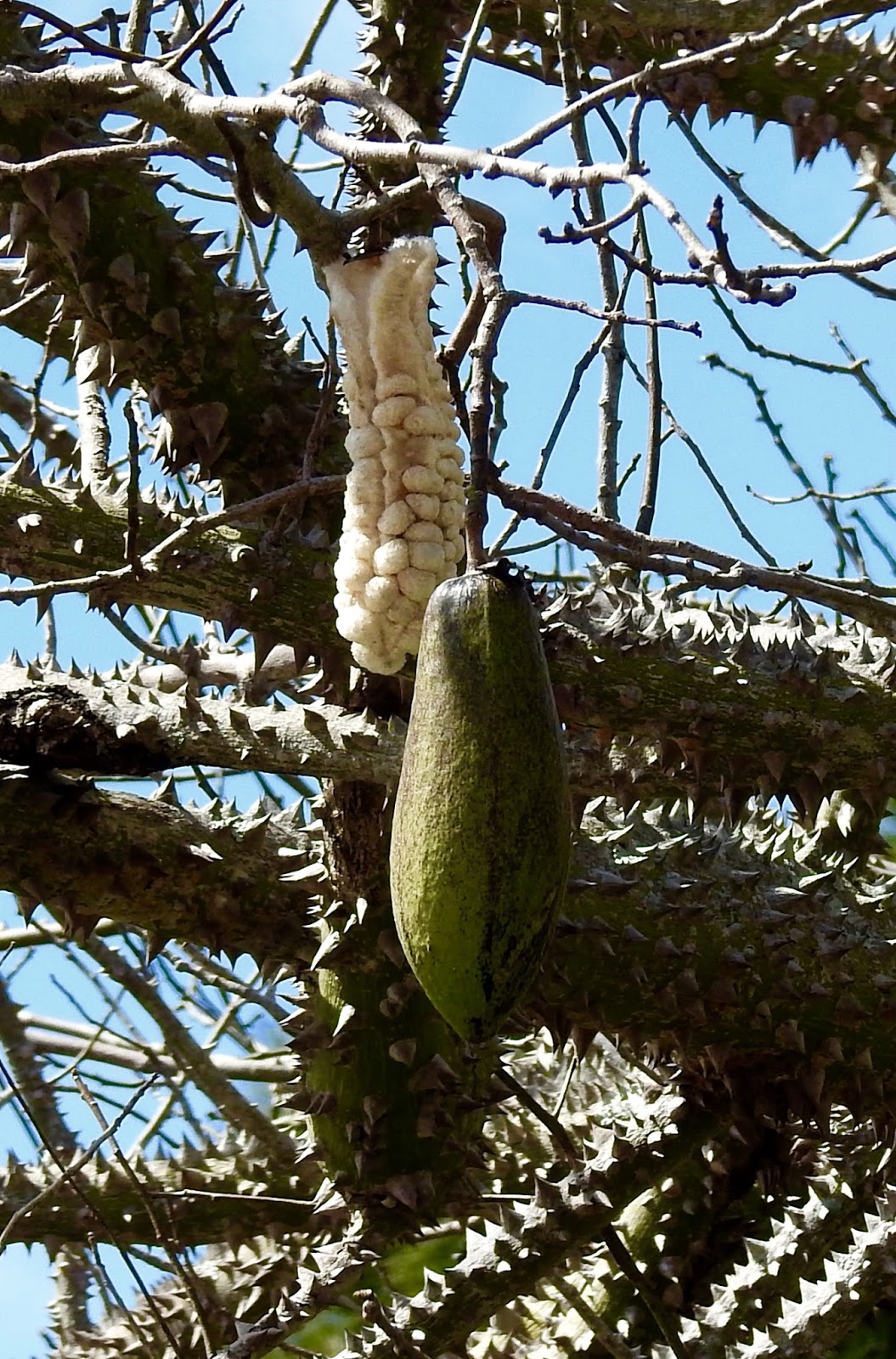
Usually, sprawling, bare branches are hung with sparse pods--luminous dark olive.  These turn into white, cottony lumps, tight as a clenched fist.  

Seed pods--with green cover and without. I like the image of the smooth green pod against the thorns on the branches.  My photo.


These gradually expand into four fluffing fingers hanging down until a storm wind carries them off--leaving the trees completely naked.
The last stage before the tree's seeds are liberated by a strong wind.  My photo.
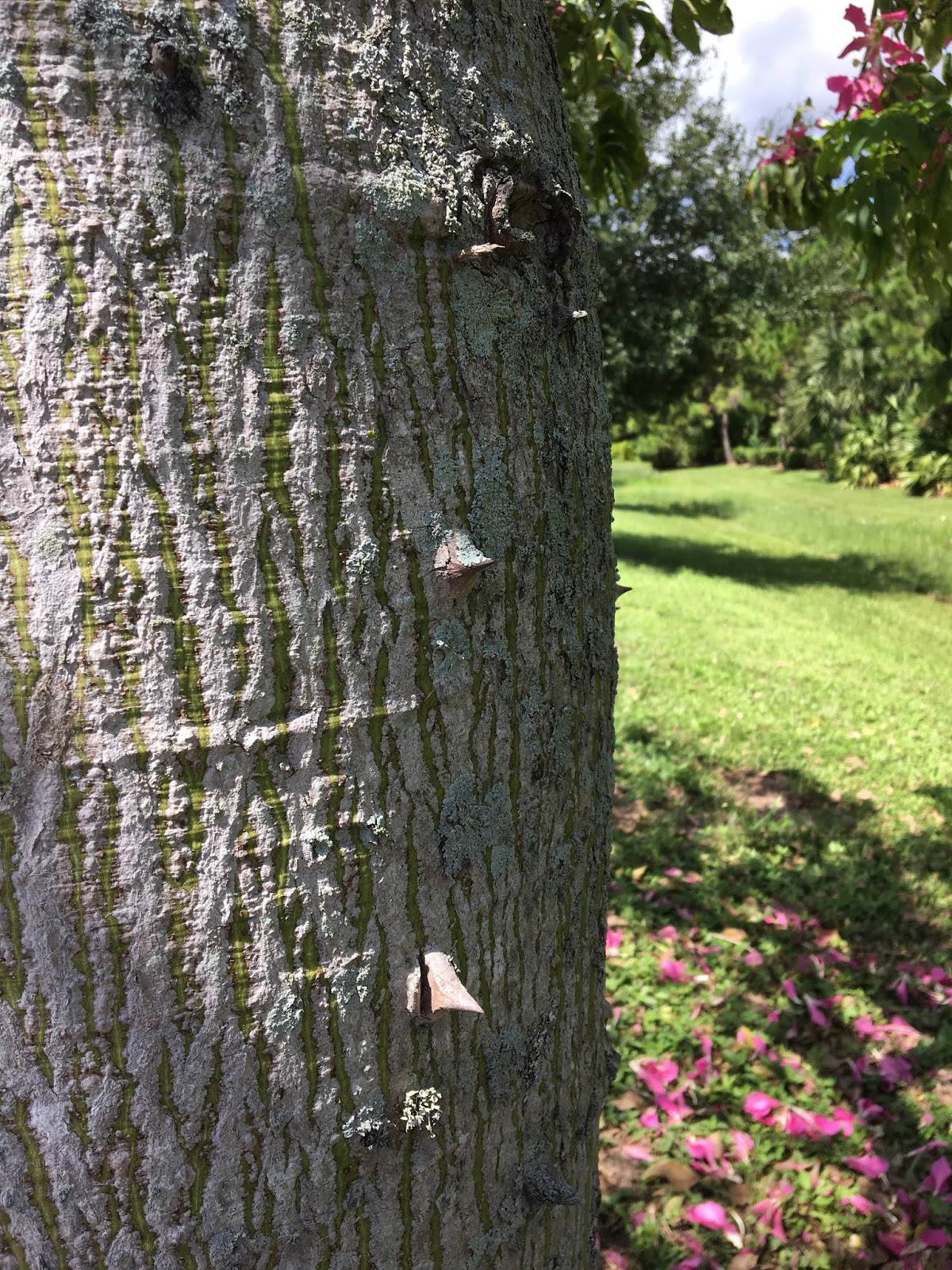
As if in response to this dearth of foliage, the trunk and branches have sprouted thousands of thorns.  If they have no leaves, at least they have something with which to protect themselves.  The only way to believe them is to see them.

Spiny thorns on trunk. My photo.
During the summer the tree is carpeted with gobs of fluffy pink clouds of petals--from afar it looks like something from a My Little Pony movie.  During this time of year, it always seem odd to me that there aren't rainbows sprouting from each tree.